

Currently Empty: 0 CFA
Law
The Reality About Defamation
DEFAMATION: KNOW THE LAW BEFORE YOU SPEAK
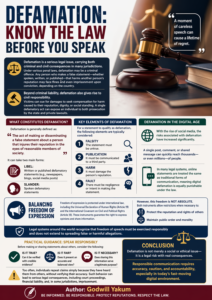
Defamation is a serious legal issue, carrying both criminal and civil consequences in many jurisdictions. Under various penal laws, defamation may be classified as a criminal offence. Any person who makes a false statement—whether spoken, written, or published—that harms another person’s reputation may face fines and even imprisonment upon conviction, depending on the country.
Beyond criminal liability, defamation also gives rise to civil responsibility. Victims have the right to initiate legal proceedings to seek damages for harm caused to their reputation, dignity, or social standing. This dual system means that a single defamatory act can expose an individual to both prosecution by the state and private lawsuits.
What Constitutes Defamation?
Defamation is generally defined as:
The act of making or disseminating a false statement about a person that injures their reputation in the eyes of reasonable members of society.
It can take two main forms:
- Libel: Written or published defamatory statements (e.g., newspapers, blogs, social media posts)
- Slander: Spoken defamatory statements
Key Elements of Defamation in Law
For a statement to qualify as defamation, the following elements are typically considered:
- Falsity – The statement must be untrue
- Publication – It must be communicated to a third party
- Harm – It must damage the person’s reputation
- Fault – There must be negligence or intent in making the statement
Defamation in the Digital Age
With the rise of social media, the risks associated with defamation have increased significantly. A single post, comment, or shared message can quickly reach thousands—or even millions—of people. In many legal systems, online statements are treated the same as traditional forms of communication, meaning digital defamation is equally punishable under the law.
Balancing Freedom of Expression
Freedom of expression is protected under international law, including the Universal Declaration of Human Rights and the International Covenant on Civil and Political Rights. These instruments guarantee the right to express opinions and share information.
However, this freedom is not absolute. Both instruments allow restrictions where necessary to:
- Protect the reputation and rights of others
- Maintain public order and morality
Legal systems around the world recognize that freedom of speech must be exercised responsibly and does not extend to spreading false or harmful allegations.
Practical Guidance: Speak Responsibly
Before making or sharing statements about others, consider the following:
- Is it true? Can it be verified with credible evidence?
- Is it fair? Does it present an accurate and balanced view?
- Is it necessary? Does sharing this information serve a legitimate purpose?
Too often, individuals repeat claims simply because they have heard them from others, without verifying their accuracy. Such behavior can lead to serious legal consequences, including court proceedings, financial liability, and, in some jurisdictions, imprisonment.
Conclusion
Defamation is not merely a social or ethical issue—it is a legal risk with real consequences. Responsible communication requires accuracy, caution, and accountability, especially in today’s fast-moving digital environment.
A moment of careless speech can result in lasting harm—to both the subject of the statement and the person who made it.
© By
— Godwill Yakum