

Currently Empty: 0 CFA
MOTIVATION
Don’t Just Hope It Works. Build the System That Makes It Work.
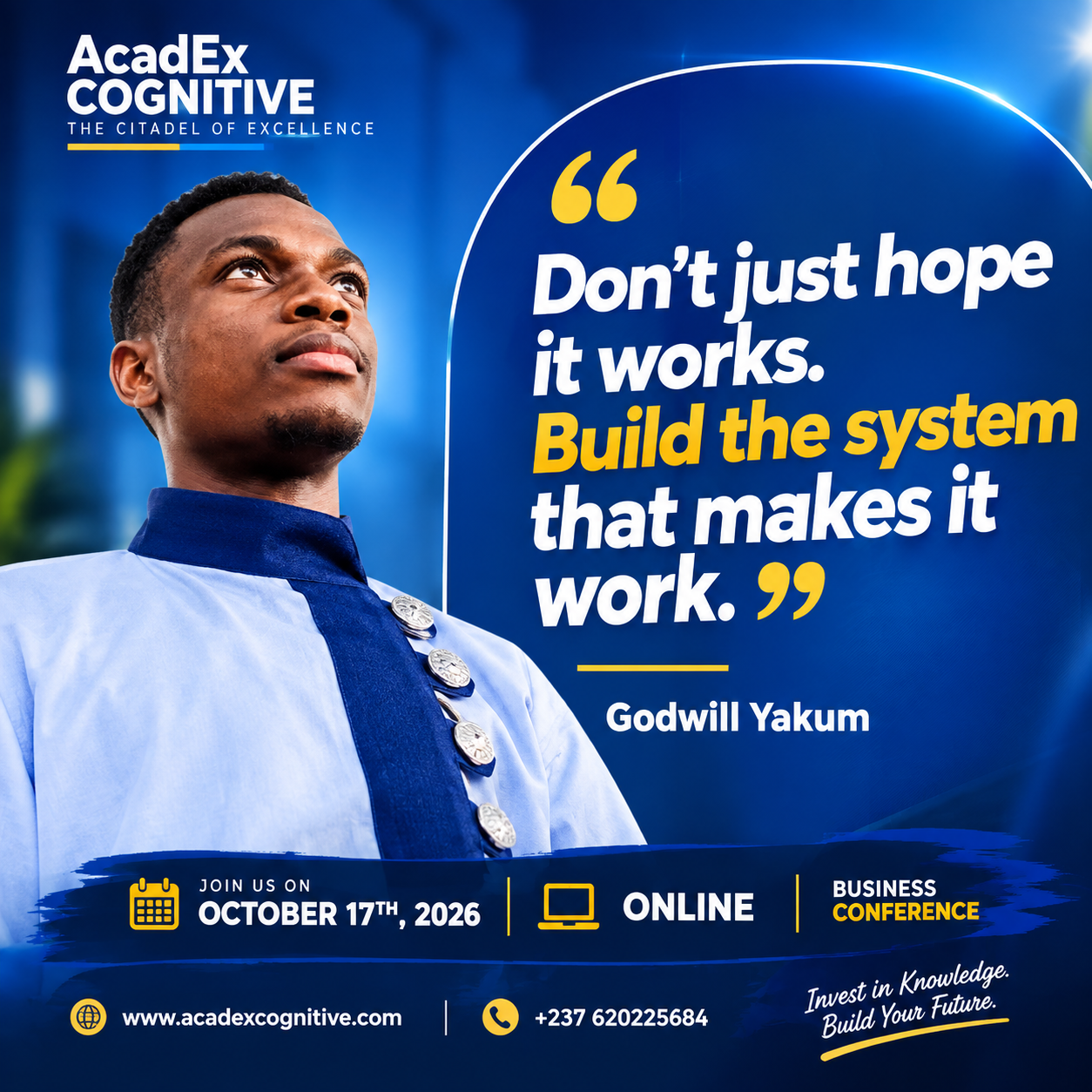
MAKING IT WORK
We Don’t Wait for It to Happen. We Build the Systems That Make It Happen.
“Don’t just hope it works. Build the system that makes it work.”
— Godwill Yakum
There is a significant difference between wanting something to happen and building the conditions that make it happen.
Many people have ambitions. They have business ideas, career goals, financial targets, personal dreams and plans for the future. But having a destination does not automatically create a path to it.
A vision gives you direction. A system gives that vision a mechanism for execution.
This is why making something work is rarely about one extraordinary moment. More often, it is about creating the right processes, habits, structures, relationships, measurements and routines—and improving them consistently.
The principle is simple:
Don’t just hope it works. Build the system that makes it work.
1. Hope Has a Place—but Hope Is Not a Strategy
Hope can give us courage.
It can keep us moving when circumstances are difficult. It can help us believe that a better outcome is possible.
But hope by itself does not answer the practical questions:
- What exactly needs to happen?
- Who needs to do it?
- When should it happen?
- How often should it happen?
- What resources are required?
- How will we know whether it is working?
- What happens when it fails?
- What will we change when the results are different from what we expected?
These are systems questions.
A person can hope for business growth without having a customer-acquisition process. A student can hope for excellent results without a study system. A professional can hope for career advancement without a deliberate learning and networking routine.
The problem is not necessarily a lack of ambition.
Sometimes, the ambition has not yet been translated into a repeatable process.
2. A Goal Tells You What You Want. A System Tells You What to Do.
Suppose someone says:
“I want to grow my business.”
That is a legitimate goal, but it is not yet an operating plan.
A system asks:
How will we attract potential customers?
How will we convert them?
How will we deliver value?
How will we follow up?
How will we measure customer satisfaction?
How will we encourage repeat business and referrals?
How will we track revenue and costs?
Now the goal has begun to acquire structure.
Business process management literature similarly emphasizes identifying important processes, documenting them, measuring their performance and continuously improving them.
This is an important distinction:
Goals describe outcomes. Systems organize actions.
You need both.
3. Systems Reduce Dependence on Motivation
Motivation is valuable, but it fluctuates.
There are days when you feel energetic and focused. There are also days when you are tired, distracted, discouraged or overwhelmed.
If everything depends on motivation, consistency becomes fragile.
A system provides structure when motivation is absent.
A student who has a defined study schedule does not have to decide from scratch every evening whether to study.
A company with a documented customer-service process does not have to reinvent its approach every time a customer makes an enquiry.
A content creator with an editorial calendar does not have to wake up every morning wondering what to publish.
A business with clearly assigned responsibilities does not have to depend on one person remembering everything.
The system creates a repeatable pathway from intention to action.
Research on habit formation provides a related insight: repeating a behaviour in a consistent context tends to increase automaticity, although the speed of that process varies considerably between individuals. In one real-world study, the time required to approach a high level of automaticity ranged from 18 to 254 days.
The lesson is not that every habit takes a particular number of days.
The lesson is that repetition and consistency matter.
4. Build the Process, Not Just the Dream
Imagine two entrepreneurs.
The first says:
“I want more customers.”
The second asks:
“What system will consistently put our value in front of the right customers, capture their interest, convert appropriate prospects, deliver a good experience and encourage them to return?”
The second question is more demanding—but it is also more actionable.
A business system might look like this:
Awareness → Enquiry → Follow-up → Purchase → Delivery → Feedback → Retention → Referral
Each stage can be examined.
Where are potential customers coming from?
How quickly are enquiries answered?
What prevents people from completing purchases?
Is the customer experience consistent?
What happens after the sale?
Are satisfied customers being encouraged to return or refer others?
Once the process becomes visible, improvement becomes possible.
You cannot systematically improve what you have never clearly defined.
5. Measure What Matters
A system without measurement can become nothing more than routine.
You need evidence.
For a business, that might include:
- Number of enquiries
- Conversion rate
- Revenue
- Customer retention
- Customer acquisition cost
- Response time
- Delivery time
- Customer satisfaction
- Repeat purchases
- Referral rates
For a student, it might include:
- Study hours
- Topics completed
- Practice questions attempted
- Test performance
- Areas of weakness
- Revision frequency
For a professional, it might include:
- Skills acquired
- Projects completed
- Professional relationships developed
- Applications submitted
- Interviews obtained
- Certifications completed
Measurement does not guarantee success. But it provides information for making better decisions.
A process-management approach commonly emphasizes measurement precisely because organizations need evidence to identify problems and improve processes.
6. When It Doesn’t Work, Diagnose the System
One of the most important shifts in thinking is learning to distinguish between “I failed” and “the current approach failed.”
Those are not necessarily the same thing.
Suppose a business launches a product and receives very few sales.
There are many possible explanations:
- The product may not meet the market’s needs.
- The target audience may be wrong.
- The price may be inappropriate.
- The marketing message may be unclear.
- The sales process may be weak.
- Customers may not trust the brand yet.
- The distribution channel may be ineffective.
- The follow-up process may be inadequate.
Simply saying “the business isn’t working” does not identify the problem.
A better response is:
“Which part of the system is not producing the expected result?”
That question changes the conversation from frustration to diagnosis.
And diagnosis creates the possibility of improvement.
7. Build Systems That Can Be Improved
A system should not become a prison.
It should become a framework for learning.
One useful cycle is:
BUILD → TEST → MEASURE → LEARN → IMPROVE → REPEAT
Build the process.
Test it in the real world.
Measure what happens.
Learn from the evidence.
Improve the process.
Then repeat.
This is closely related to continuous-improvement thinking in quality and process management. Organizations can identify critical processes, document them, establish measurements and then manage and improve those processes over time.
The objective is not to create a perfect system on the first attempt.
The objective is to create a system that can become better.
8. Don’t Build Complexity for the Sake of Looking Professional
There is another danger.
Some people hear the word system and immediately think of complicated software, expensive tools, lengthy procedures and large teams.
A system does not have to be complicated.
A simple system can be powerful.
For example:
Every enquiry received → respond within a defined period → record the prospect → follow up → document the outcome.
That is a system.
A simple spreadsheet can be a system.
A checklist can be a system.
A calendar can be a system.
A documented procedure can be a system.
A weekly review can be a system.
The U.S. Small Business Administration’s recent business-systems training, for example, highlights practical tools such as responsibility charts and process mapping as ways businesses can create effective operating systems and prepare for growth.
The objective is not complexity.
The objective is repeatability.
9. Build Systems Around People, Not Just Tasks
A system also needs ownership.
If everyone is responsible, sometimes nobody is responsible.
Every important process should have clarity around:
Who does what?
When do they do it?
What standard is expected?
What happens if there is a problem?
Who reviews the result?
This becomes especially important as organizations grow.
A business owner who personally handles every decision may be able to manage a small operation. But growth introduces more customers, more transactions, more employees, more communication and more complexity.
Without systems and clear responsibilities, growth itself can create disorder.
Process-management research and practice therefore often emphasize process ownership, measurement and regular review rather than simply assigning isolated departmental tasks.
10. Don’t Abandon the Vision Too Quickly
Sometimes what needs to change is not the dream.
It is the method.
You may need to change:
the strategy, not the destination.
the process, not the purpose.
the structure, not the vision.
the approach, not the ambition.
Of course, there are situations where a goal itself should be reconsidered. But failure of one method is not automatically evidence that the underlying objective is impossible.
A failed strategy can provide information.
A disappointing result can reveal a weakness.
A rejected proposal can expose a communication problem.
A poor campaign can teach you something about your audience.
A failed product can provide evidence about market needs.
The mature response is not blind persistence.
It is informed adaptation.
11. The People Who Make Things Happen Build Infrastructure for Their Goals
Consider what happens behind almost every significant achievement.
There is usually infrastructure.
An athlete has a training programme.
A university has academic systems.
A hospital has clinical procedures.
A company has operating processes.
A successful publication has an editorial process.
A large event has planning, registration, communication and logistics systems.
The visible result is often only the final layer.
Behind it is a structure that supports repeated execution.
This is why we should stop romanticizing the idea that success is simply the result of one great opportunity.
Sometimes the opportunity arrives.
But the system determines what you can do with it.
12. Start Building What You Need Now
You do not need to wait until you have a large organization.
Start with one important outcome.
Ask:
What am I trying to achieve?
Then ask:
What actions consistently move me toward it?
Then:
How can I make those actions easier to repeat?
Then:
How will I measure whether they are working?
Then:
What will I change when the evidence tells me something needs to change?
This simple framework can transform an abstract ambition into an operating system.
Making It Work
There will always be uncertainty.
There will always be unexpected obstacles.
There will always be factors beyond our control.
But uncertainty does not mean helplessness.
We can still prepare.
We can still learn.
We can still organize.
We can still measure.
We can still adapt.
We can still build.
And when something doesn’t work, we can ask a better question:
“What system needs to change?”
That is the mindset behind making things work.
Not blind optimism.
Not endless waiting.
Not pretending that every plan will succeed.
But the willingness to take an idea, translate it into action, create structure around it, learn from the results and continuously improve.
Don’t just hope it works.
Build the system that makes it work.
BUSINESS CONFERENCE — OCTOBER 17, 2026
If you are building a business, developing a professional career, launching an idea or trying to turn an ambition into something sustainable, this conversation matters.
Join us on October 17th, 2026 for the Online Business Conference.
Come to learn, connect, exchange ideas and explore practical approaches to building businesses and professional ventures that are designed not merely to start—but to work.
Registration Fee: 2,000 FCFA
REGISTER NOW →
https://www.acadexcognitive.com/business-conference-2026/
Online • October 17th, 2026
For enquiries: +237 620225684
www.acadexcognitive.com
Invest in Knowledge. Build Your Future.
— Godwill Yakum